
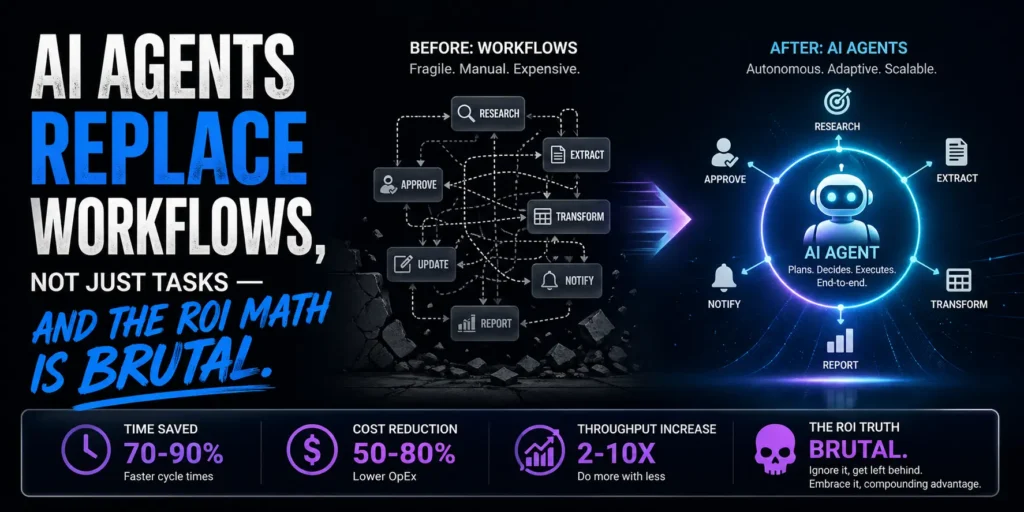
Every founder at Series A faces the same pressure: grow revenue per headcount faster than burn. The future of artificial intelligence resolves that tension, but not through the chatbot you bolted on last quarter. The shift that matters runs deeper — from AI-assisted tasks to AI-driven workflows.
Klarna replaced 700 contract customer service agents with a single AI system in 2024. Their public numbers showed that AI handled two-thirds of customer chats in the first month, cutting average resolution time from 11 minutes to 2. That is not a productivity boost — that is a structural cost advantage baked into their unit economics before they raise the next round.
67%
of Klarna chats handled by AI within 30 days of deployment
5×
faster resolution time vs. human agents on the same queries
$40T
projected global economic value from AI by 2030 (McKinsey, 2023)
The error Series A founders make: they treat AI as a department-level tool — a feature for the product team, a summarizer for sales. Companies that win the next decade treat AI as an operating system that touches every revenue-generating motion. The future of artificial intelligence does not care about your org chart.
Multimodal models unlock markets that text-only AI locked out
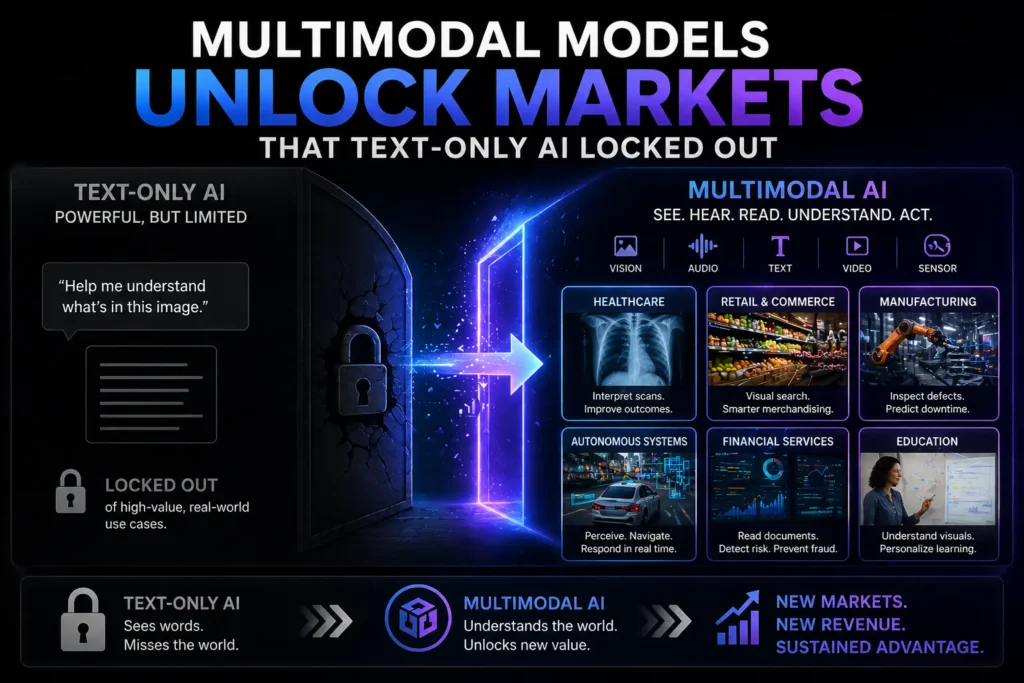
GPT-4 Vision, Gemini 1.5, Claude’s vision capabilities — multimodal models that process images, audio, documents, and text simultaneously now sit at the frontier. This matters for your TAM calculation more than most founders realize.
Consider the construction industry. Procore integrated AI-powered photo analysis that flags safety violations on job sites by scanning uploaded images against OSHA guidelines. Their customers catch hazards in minutes instead of days. That product cannot exist without multimodal AI, and it commands a premium that pure SaaS workflows cannot.
Founders who frame the future of artificial intelligence as “better autocomplete” will build incrementally better products. Founders who frame it as a new sensing layer for their industry will build defensible ones.
The future of artificial intelligence pushes toward models that handle voice, video frames, sensor data, and structured records in a single context window. That means verticals with rich non-text data — healthcare imaging, industrial inspection, real estate, logistics — face a window of two to three years where first-mover multimodal products acquire customers at low CAC before incumbents catch up. Speed matters here. The model capabilities already exist. The question is who builds on top of them first.
Foundation model costs drop 10× every 18 months — build your pricing model accordingly
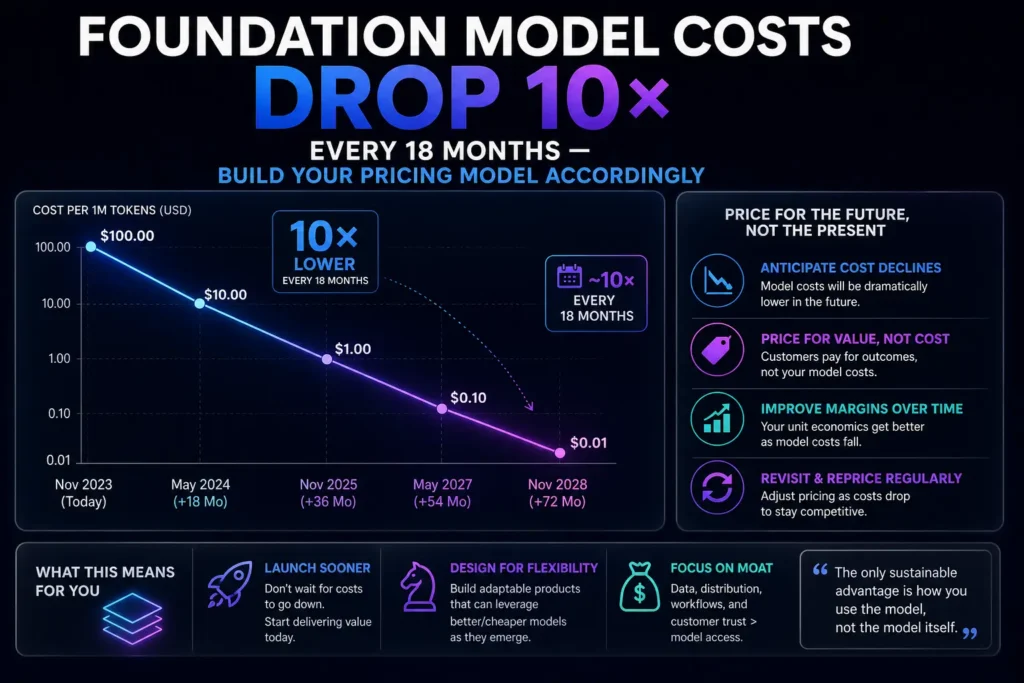
Anthropic researcher Zack Witten noted publicly that inference costs dropped roughly 10× in 2023 alone. That trend continues. GPT-4-class capability that cost $60 per million tokens in early 2023 ran at under $2 per million tokens by mid-2024. The future of artificial intelligence means the cost structure for AI-native products improves faster than any other software category in history.
For Series A founders, this creates a specific strategic window. Do not build your unit economics around current inference costs — they will not hold. Instead, build for the cost curve. Products priced today on AI as a premium feature will face compression as the feature becomes table stakes. Products priced on outcomes — cost per resolved ticket, cost per qualified lead, cost per approved document — benefit from cost deflation without pricing pressure.
Harvey, the AI legal platform, charges law firms per matter, not per token. As their underlying model costs drop, margins expand automatically without renegotiating a single contract. That pricing architecture proves more durable than per-seat SaaS in a world where AI capability commoditizes. Build the contract now that benefits from the cost curve you can already see coming.
10×
inference cost drop per year at the frontier — documented 2023–2024
$2
per million tokens for GPT-4-class capability by mid-2024, down from $60
Reasoning models change who builds the product — and who competes with you
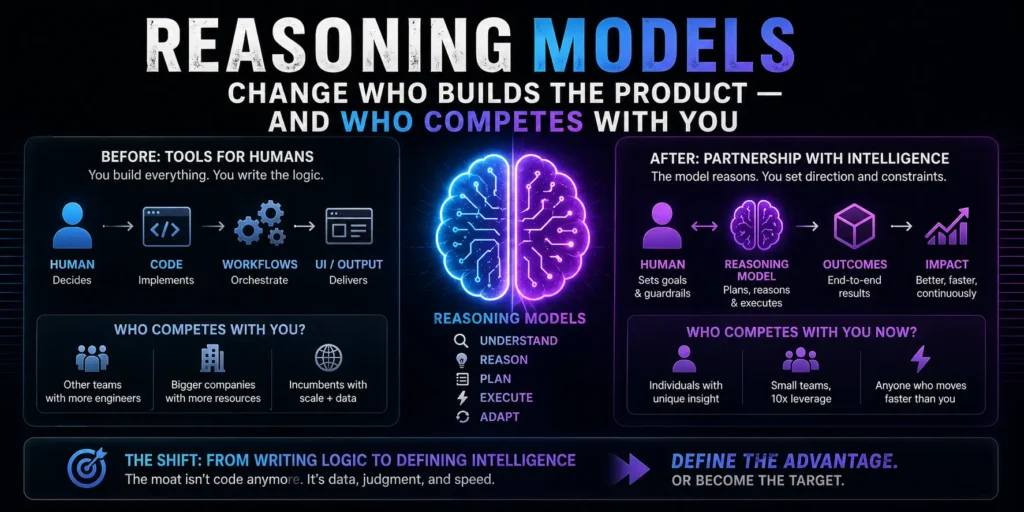
OpenAI’s o1, Google’s Gemini Thinking, and Anthropic’s extended thinking mode share a common architecture: chain-of-thought reasoning that lets models work through multi-step problems rather than pattern-match to an answer. For technical founders, this shifts the competitive landscape in two ways simultaneously.
First, reasoning models reduce the engineering labor required to build AI features. Complex prompt engineering that previously required a senior ML engineer to iterate over weeks now resolves in hours when the model reasons through edge cases itself. Replit used AI reasoning to generate complete codebases from natural language specs — their own engineers shipped features they previously estimated at three sprint cycles in a single day. That compression accelerates your roadmap without adding headcount.
Second, the same models that accelerate your build also accelerate your competitors’ builds. The future of artificial intelligence does not protect incumbents. It empowers fast-moving teams with ten engineers to ship products that previously required fifty. Your moat cannot rely on AI capability alone — it compounds with distribution, proprietary data, and customer relationships that reasoning models cannot replicate from scratch.
Founders who understand this use AI to move faster on the dimensions where speed creates lock-in: onboarding depth, integration density, customer data flywheels. The AI does the coding. You do the positioning.
The future of artificial intelligence does not reward companies that adopt AI — it punishes companies that wait, and the penalty compounds every quarter they delay. Build the AI-native workflow now, price for the cost curve that already exists, and ship
the product your competitors will still be planning when your Series B close
Written by gaurdigital.com