
AI and the Future: What Series A Founders Must Build For Now
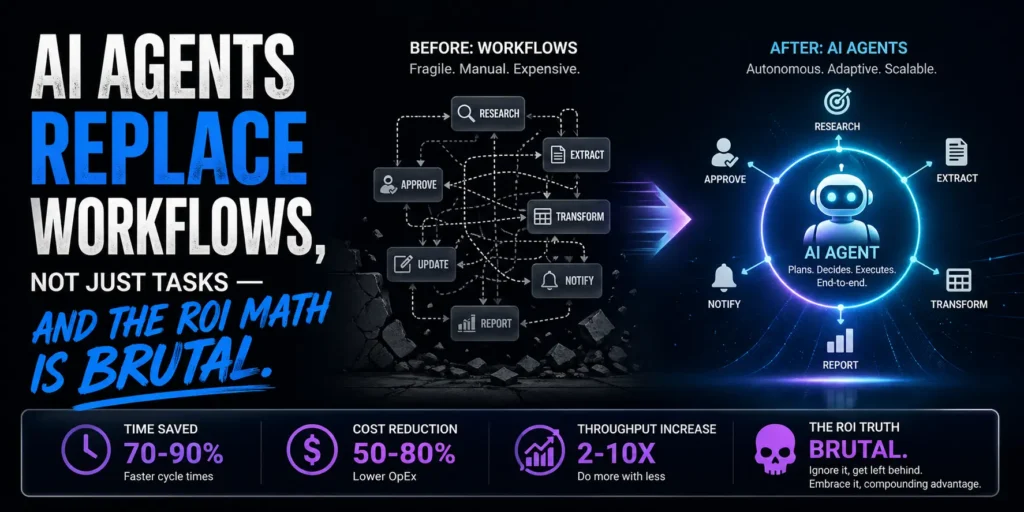
Every company that dismisses AI as a feature will wake up to find AI-native competitors have already eaten their margin, their hiring pipeline, and their roadmap. H2: The Compounding Advantage That Traditional SaaS Can’t Match AI and the future of software aren’t converging slowly — they already converged. The founders who recognize this aren’t philosophizing about AGI timelines. They’re shipping products where the core value loop gets faster and cheaper with every user interaction, not slower and more expensive. Traditional SaaS scales linearly. More customers mean more infrastructure costs, more support tickets, more implementation headcount. An AI-native product inverts this. Cursor — the AI-first code editor — reached $100M ARR with a team that would staff a mid-size engineering department at a legacy software company. Their competitive moat isn’t a feature list. It’s a feedback loop: more usage generates better model fine-tuning signals, which improves output quality, which drives more usage. That loop compounds. A B2B SaaS built on Salesforce workflows does not compound. It accumulates. For Series A founders, the strategic question isn’t “should we add AI?” It’s “does our product get meaningfully better as usage scales?” If the answer is no, you’re building something a well-funded AI-native competitor will undercut within 24 months. Retention curves confirm this: Klarna’s AI assistant handled the equivalent work of 700 full-time agents in its first month, dropping average ticket resolution time from 11 minutes to under 2. The founders who built competing fintech support tools on human-in-the-loop models watched their unit economics collapse in real time. AI and the future of competitive positioning belong to the companies that treat intelligence as infrastructure, not decoration. H2: Where The Real Lives And Its Not Where You’r Looking Most Series A teams allocate AI investment into two buckets: developer productivity (Copilot licenses, internal tooling) and a customer-facing chatbot that nobody uses after week three. Both are fine. Neither is the bet. The ROI that restructures your business lives in your decision layer — the place where your team makes calls that cost money or time. Legal review, contract redlining, demand forecasting, pricing adjustments, customer health scoring. These aren’t glamorous. They’re where hours disappear and errors compound. Harvey AI didn’t build a legal chatbot. It built a system that lets associates move from 4-hour contract reviews to 40-minute ones, at scale, without proportional headcount growth. Enterprise law firms pay $40,000+ per seat annually because the ROI math takes about thirty seconds to run. That’s the template. For technical founders, the framework is simple: find the decision that (a) your team makes repeatedly, (b) requires synthesizing large amounts of context, and (c) currently costs senior hours to execute. Then ask whether an AI layer can compress the time-to-decision by 60% or more. If yes, that’s where you build — not a chatbot, not an AI “mode,” but a core workflow transformation with measurable output. AI and the future of enterprise sales cycles also shift here. Buyers at Series B and beyond now ask about AI ROI in procurement conversations. “We use AI for our engineering team” doesn’t move procurement. “Our AI-assisted workflow reduced customer onboarding from 14 days to 3, confirmed across 40 enterprise accounts” does. H2: The Infrastructure Bets That Will Define Winners in 36 Months The model wars are mostly noise for founders building products. GPT-4o, Claude, Gemini — the delta between them shrinks every quarter and will approach zero for most use cases. The actual infrastructure decisions that will separate winners from acqui-hires fall into three categories. Data flywheels. The companies that will dominate vertical AI aren’t the ones with the best prompts — they’re the ones with proprietary training data that no API call can replicate. Veeva built a moat in life sciences software over 20 years through data accumulation. AI-native vertical startups can compress that timeline, but only if they architect data capture into their product from day one, not as a retroactive integration. Evaluation pipelines. Most AI products ship broken and don’t know it. Output quality degrades across edge cases that nobody tested because nobody built a systematic way to test them. The founders shipping reliable AI products run evals the way strong engineering teams run integration tests — automatically, on every deploy, against a ground-truth dataset. Brex, Notion, and Linear all have internal AI eval frameworks. You should too before you reach 1,000 active users. Latency as UX. Users forgive slow dashboards. They abandon slow AI. Every 100ms of additional latency in an AI response drops completion rates measurably. Streaming responses, aggressive caching, and model routing (using smaller, faster models for simpler queries) aren’t nice-to-haves — they’re product retention levers. Founders who treat inference latency as a backend concern rather than a product metric will see it in their 30-day retention numbers. AI and the future of infrastructure investment points to one conclusion: the moat isn’t the model, it’s the system around the model. H2: Hiring and Org Design for AI-Native Speed AI and the future of team structure are inseparable. The founders who move fastest aren’t those with the largest engineering teams — they’re the ones who’ve redesigned how work flows through their organization. The ratio that matters: at Midjourney, approximately 40 people built a product used by 20 million users. That’s not an accident of timing. It’s the result of deliberate decisions about where humans add irreplaceable value and where AI handles execution. For Series A companies, the equivalent is understanding that a 3-person growth team running AI-assisted experiments can outship a 12-person team running manual processes. Practically, this reshapes hiring. The new benchmark for an individual contributor isn’t raw output — it’s the force-multiplier ratio. A growth marketer who runs 40 AI-assisted experiments per quarter generates more signal than one who runs 8 manually polished ones. A sales engineer who uses AI to personalize 200 outbound sequences per week closes different numbers than one sending 30 handcrafted emails. Hire for the former. Train your current team to operate like the former. The organizational risk isn’t that
AI and the Future: What Series A Founders Must Build For Now Read More »